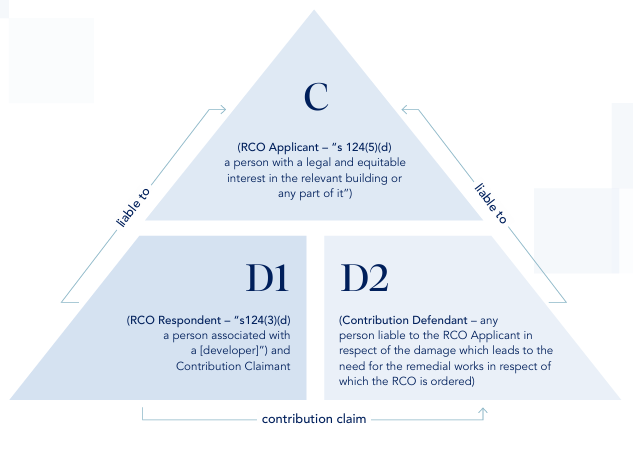
In the Keating Chambers BSA Update for July 2025, I addressed the question of whether a contribution claim could be founded on a remediation contribution order (“RCO”).
I formed the view that a contribution claim could indeed be founded on an RCO, but that the likely compass of any such claim would appear to be limited to just one of the five applicants for an RCO, viz the “interested persons” in section 124(5), namely, “(d) a person with a legal and equitable interest in the relevant building or any part of it” and just one of the four respondents to an application for an RCO, viz the “specified persons” in section 124(3), namely “(d) a person associated with a person within any of paragraphs (a) to (c)” and, of those, “(c) a developer …”.
In short, the respondent against whom the RCO is ordered (ordered because he is liable to the applicant for an RCO under s 124 in respect of meeting costs incurred or to be incurred in remedying or otherwise in connection with relevant defects relating to the relevant building) can bring contribution proceedings against any other party liable to the applicant in respect of the damage which leads to the need for the said remedial works. Given the breadth of obligations owed to “(d) a person with a legal and equitable interest in the relevant building or any part of it” (the applicant) under the DPA, including those responsible by design or workmanship for the original defects, there seems to me to be no reason why the respondent to the RCO (viz the person associated with the developer) could not bring proceedings in contribution in respect of his liability under the RCO to the applicant. Bearing in mind the “contribution triangle”, in this example the diagram can be found at the end of the article for reference.
Could a Contribution Claim be Founded on a BLO?
I am now asked by the Editors of the Keating Chambers BSA Update (March 2026) whether a contribution claim could be founded on a building liability order (“BLO”).
Who might be parties to such a contribution claim, and what might contribution be sought in respect of? There are two relevant groups of persons.
The first group comprises the three persons involved with a BLO application under s 130. First, the person applying for a BLO, which I will call the “BLO Applicant”. Second, the body corporate which is liable for the purposes of s 130(2), which I will call the “Original Body”. Third, the body corporate specified in the BLO, which I will call the “Specified Body”.
The second group comprises those persons liable for a “relevant liability” (as defined in s 130(3)) and those persons to whom they are so liable. A “relevant liability” is a liability under the DPA, or a liability in respect of a “building safety risk”, in turn defined by s 130(6) as “a risk to the safety of people in or about the building arising from the spread of fire or structural failure”. I will call these “DPA / BSR liabilities”.
A claim for contribution can only be made by B in respect of an identifiable amount of money to which C can be ordered to make contribution: BDW Trading Ltd v URS Corporation Ltd [2025] 2 WLR 1095 [SC] at [224-231]. However, it should be possible, depending upon the shape of the proceedings in which the BLO is claimed, to claim contribution in respect of monies likely to be recovered in the proceedings via the BLO because proceedings for contribution can commence before the right to contribution has accrued by operation of rules of court in legal proceedings in which A sues D1 [238].
How might a claim for contribution unfold alongside a claim for a BLO? Let us take a simple example. The Owner sues the Original Body (say, a developer) for damages under either s 1 DPA or in respect of a building safety risk. The Owner also sues the Specified Body for a BLO on grounds that the Specified Body is associated with the Original Body. The Specified Body wishes to sue others in the development chain, but is owed neither DPA duties, nor duties in contract or tort. However, in circumstances where the Owner’s claim for a BLO is successful, the Specified Body becomes, by definition, liable to the Owner in respect of the Original Body’s DPA / BSR liabilities and so can claim contribution from others liable to the Owner in respect of DPA / BSR liabilities. In short, the Specified Body can bring contribution proceedings under Part 20 against another person liable to the Claimant for the same damage in respect of which the Original Body is liable to the Claimant. The contribution defendant can then in turn claim contribution from anyone else liable to the Owner in respect of DPA / BSR liabilities, and so on.
But what about this example? An original developer (now insolvent) would have been liable to the Owners under s 1 DPA for serious structural defects. The parent of the original developer decides to carry out remedial works in respect of the structural defects on the basis that it (the parent) was associated with the original developer and so was at risk of having a BLO ordered against it in respect of the original developer’s liability.
The parent of the developer wishes to recover from the original contractor, but that too is now insolvent, and so turns to the original contractor’s parent. Can the parent of the developer in these circumstances recover contribution from the parent of the contractor?
This seems less straightforward. It may well be pointed out that the parent of the developer can only conceivably be liable in respect of the original developer’s liability if a BLO is ordered. Until a BLO is ordered against the parent of the developer, its claims cannot even get off the ground. What is the answer to this?
One possibility is that the parent developer reminds itself that “liable” in section 1(1) of the Civil Liability (Contribution) Act 1978 means not “held liable” but “responsible in law” [252]. On that basis, it would be open to the parent developer to plead and prove that, had someone (for example, the Owners) claimed a BLO against it, such a claim would have succeeded. That, it could be argued, would be sufficient for a finding — in proceedings brought by the parent developer against the parent contractor — that the parent developer was “liable” to the Owners for the purposes of a claim for a BLO and an accompanying claim for contribution, without the need for a BLO actually to have been ordered against the parent developer. One potential difficulty with this approach is that the remedy of a BLO is discretionary, not relief that follows as a matter of right given certain premises. It might be sought to distinguish the position in other types of proceedings, where if claims are proved there is a right to relief, from the position in the case of a BLO, where the remedy is discretionary. The answer to this might simply be that no more is required than to prove that the discretionary element would have been met, but it is by no means clear.
Another possibility is that the parent developer seeks a BLO in respect of itself as part of a claim for a BLO against the parent contractor so that, if successful, the parent developer becomes liable in respect of the original developer’s liability to those (including Owners) to whom the original developer was liable. So armed, the parent developer may now seek a BLO against the parent contractor in respect of the original contractor’s liability and then seek contribution in respect of their now mutual liability to Owners. The notion that the parent developer seeks a BLO in respect of itself might be thought obscure, and probably amounts to another article in its own right. I say no more about it for now save these two things. First, such a notion is unlikely to have figured much in Parliament’s thinking when enacting the BSA. But second, there seems to be nothing on the face of s 130 which (at first blush) prevents it. Whether or not the prospect is a realistic one will need to await a future edition of the Keating Chambers BSA Update. Food for thought.